Rooted in East Boston
Weaving housing, culture, and ecology through clustered density


Type:
Semester:
Year:
Location:
Scope of Project:
Instructors:
Academic Harvard GSD (Collab with Nisreen Tarbell)
Core Studio 1 Elements of Urban Design
Aug’25 - Oct ‘25
East Boston, Massachussets
Urban Research and mapping, Urban Design
Dana McKinney White, Stephen Gray, Alex Yuen, Peter Rowe, Rahul Mehrotra, Michael Manfredi, Maurice Cox
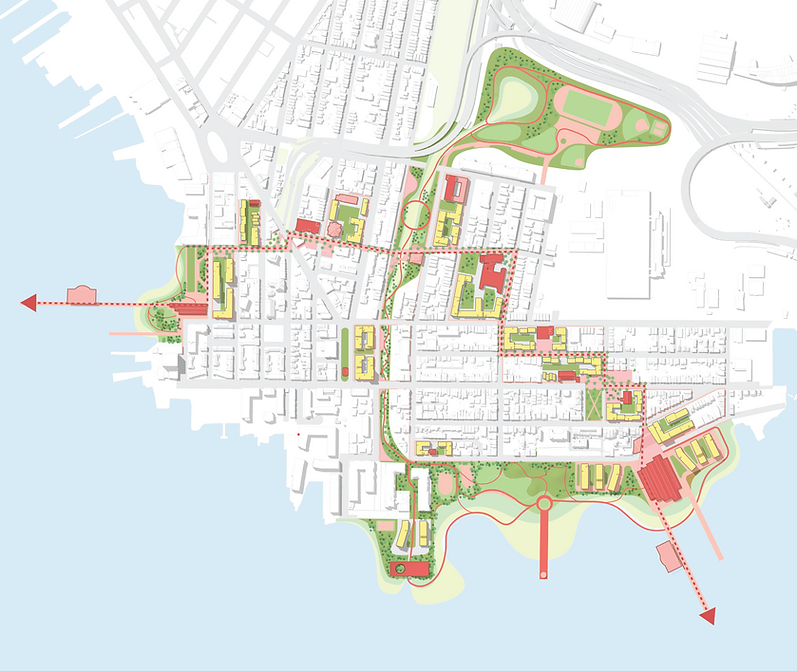
East Boston faces twin pressures of climate vulnerability and displacement. This urban design proposal responds by densifying housing around existing cultural anchors and provides missing community programs like schools, healthcare facilities, arts organizations, and community hubs that sustain vulnerable and marginalized communities. The strategy weaves three interconnected systems: a Cultural Corridor that clusters 3,460 new housing units around twelve community anchors, ensuring residents remain proximate to essential social networks.
An Ecological Corridor of green infrastructure, including wetland parks, rain gardens, detention basins, and stormwater plazas, manages flooding while creating accessible public realm. A diversity of housing typologies accommodates varied household structures and income levels. Together, these interventions strengthen existing social infrastructure, provide permanently affordable housing, and build climate resilience, resulting in multigenerational stability and cultural continuity rooted in East Boston.

East Boston’s urban fabric is defined by its people. Morning commutes begin at Maverick Station, connecting residents to downtown jobs. Weekends activate parks with pick-up soccer games, family picnics, and cultural festivals celebrating the neighborhood’s immigrant heritage. This daily choreography reveals a rich network of cultural anchors of schools, healthcare centers, churches, arts organizations, yet these institutions operate in fragmentation for the ethnically diverse users criss-crossing the neighborhood multiple times daily because housing, services and public spaces lack connective tissue.
These interventions form an anti-displacement framework grounded in East Boston’s lived reality. Rather than imposing new development that erases community, the project strengthens existing social infrastructure, provides permanently affordable housing, and builds climate resilience through design. The result is multigenerational stability, cultural continuity, and climate adaptative urbanism rooted in the people and place of East Boston.